Posted on Leave a comment

Q-Proxies Quick Start Tutorial

Introduction

People who usually work with heavy 3dsMax scenes, with a great amount of objects and polygons, often have to struggle against 2 factors:

  1. Low viewport performance, wich makes scene navigation and manipulation a real pain.
  2. Giant file size, wich causes very long loading/saving times.

These problems result in frustration, wasted time and a low productivity.

Q-Proxies helps you quickly downsize your heavy scenes through the automatic creation of proxy meshes, amazingly improving the viewport performance and reducing the loading/saving times. It’s an extraordinary timesaver that will greatly speed up your workflow and make your life much easier.

How it works

Q-Proxies helps you identify meshes in your scene with a high number of faces, through the use of object filters. Then, automatically replaces them with proxy meshes, wich are generally lowpoly versions of those objects, and stores the original ones (called references) in separate 3dsMax files. When you make a render, the high-resolution references are temporarily brought back to scene, aquiring the changes you made to their proxies.
This way you end up with a lightweight scene, with smooth viewport navigation, that loads and saves much faster, so you can work comfortably and efficiently.

The main difference between Q-Proxies and other proxy objects (created with third-party render engines or plugins) is that the proxy creation process here is automatic. You don’t need to manually build your proxies one by one, or plan how to optimize your scene before you actually create it. Q-Proxies can generate multiple different proxies at once, fast and effortlessly. And the best of all, it’s compatible with all render engines and third-party proxy objects, because it works independently from the current renderer and uses 3dsMax standard Editable Meshes, wich you can edit at any time.

The general procedure is:

  1. Set wich objects to convert to proxies / Configure Object Filters.
  2. Select the Preset that best match the type of objects you are targeting.
  3. Optionally, adjust a few proxy creation parameters (like mesh type, polygon reduction, animation baking, etc.)
  4. Press ‘Generate Proxies’.

Interface

The plugin’s UI has 5 different sections. The 3 main sections are the ones initially visible when you run the plugin:

  1. Object Filters
    Include options for filtering your scene meshes by number of faces, size, static/animated, and others.
  2. Create Proxies
    Here you setup the parameters for creating the proxies: type of proxy mesh, amount of polygon reduction, bake animation, etc.
  3. Display/Render Options
    Controls to set how to display proxy meshes in scene and whether to activate or not the replacement of proxies during render.

There are 2 more tabs at the middle, with advanced options and help (Manage/Tools and Help/About), wich are not covered by this introductory tutorial.

Quick Starting Example

Let’s pretend we have an architectural interior scene: an art gallery. For simplicity, this sample scene will contain just 2 elements of the art gallery: columns (cylinders) and sculptures (teapots).

So first, we are going to build this simple scene with high resolution meshes to make it heavy, and then we will use Q-Proxies to reduce it to a very lightweight scene.

  1. In a new 3dsMax scene, create a cylinder to represent a column. Give it 5 height segments, 1 cap segment and 24 sides. The radius and height don’t matter.
  2. Make 6 instances in total and arrange them like the image above, to place our sculptures in the center, surrounded by the columns.
  3. Create a teapot to represent a scuplture, with about 1/3 the height of a column. Give it 64 segments and add a TurboSmooth modifier to it, with 1 iteration. Convert it to Editable Mesh.
    So now it will have more than 1 million faces. This will be our high resolution mesh.
  4. Now make 10 copies in total (not instances). Arrange them the way you like, in the center of the scene. Save your scene.
    You have now a scene with more than 10 million faces (triangles), with a file size of about 452 Mb. Check it out.
    Supposing this is a very complex scene, with lots of objects, polygons, modifiers, textures, etc, you would be probably experiencing a low viewport performance and waiting too long for saving and loading the scene. So we’ll use Q-Proxies plugin to solve this problem.
  5. Open Q-Proxies. (If it was already open, please close it and re-open it, so it resets to default values)
  6. Let’s assume that the objects in our scene are hard to identify and select. So, let’s use Q-Proxies filters to identify the high resolution objects, so we can replace them later with proxies.
  7. Go to Objects Filters section (at the top) and check the radio button called All Geometry, instead of the default Selection. This tells the plugin to operate on all geometry in scene, not only on selected objects.
  8. Leave the other options by default and press the ‘Select‘ button at the bottom right of Object Filters section. This selects filtered objects.
    A message appears: “No objects found after filtering”. That’s because the ‘Max. num. faces’ value is too low. Our teapots have more than 1 million faces each one.
  9. Increase this value to 2,000,000 (2 million). Press ‘Select‘ again.
    The 10 teapots are now selected.
  10. Go down in the UI to the bottom of Create Proxies section and locate Presets. Choose the option ‘Sculptures / Statues’.
    These presets help you quickly setup the main parameters for the proxy creation process.
  11. Press the big button ‘GENERATE PROXIES’.
  12. A message will show up, asking you to confirm the action. Go on.
  13. In this case, another message will show up: “There’s a lot of information to process. […] Continue anyway?”.  (If you process more than 500 objects or 1 million polygons, this additional warning will appear). Confirm again.
  14. Q-Proxies will start processing the objects and generating the proxies.
    It should take no more than 10 to 30 seconds in this simple scene.

When the process ends, please save the scene with a new name to compare it with the previous.

Now you will notice some incredible things in your scene:

  • If you deselect all and see the scene in shaded mode, there’s almost no difference. The general look of the objects was preserved.
  • Every teapot is now a lowpoly mesh, with about only 1,300 faces.
  • All teapots are now instances of each other.
  • Every teapot is an Editable Mesh with a modifier applied, called ‘Proxy Attributes‘. This means that object is now a Q-Proxies proxy mesh.
  • The whole scene has now less than 15,000 total faces!
  • The scene file size was amazingly reduced to just about 650 kb.

This is the magic of Q-Proxies! 😀

Now zoom in to one of the teapots, place a camera and render a very close-up shot. Use any production renderer.

You will see the high resolution mesh at the render!

Now, while you easily manipulate a very light scene, with low resolution proxies, everything looks great and polished in the final render.

I hope you enjoyed this starting tutorial. Just play around with the plugin and its parameters and take a look at the other tutorials and the plugin’s manual for further learning.

Cheers! 🙂

Share
Posted on Leave a comment

SubSpline – Quick Start Tutorial

SubSpline is an Advanced Subobject Selector & Material IDs Editor for spline shapes in Autodesk 3dsMax.

With this plugin, you can edit your shapes way faster, using its smart and efficient tools for selecting vertices, segments and spline subobjects.

SubSpline is also the perfect tool for managing the material IDs in your splines, due to its extensive set of functions ment for this porpose.

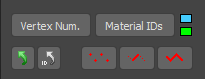
Some tools in this plugin work only in subobject level (like the ones in Select Subobjects section), while others can work both at base or subobject level. See the image above.

SubSpline was ment to work in parallel with 3dsMax Editable Spline tools. You can switch between the different subobject levels directly from the script’s UI, with the vertex/segment/spline buttons, at the Main Panel.

Vertex/Segment/Spline (icon buttons):
These 3 check buttons are clones of the ones in Editable Spline parameters and have the same function: enable or disable the corresponding subobject level edition.
When active, all the controls in Select Subobjects section become enable and ready to operate.
You can hold CTRL+button to convert the current subobject selection to a different type (like you do in 3dsMax Editable Poly).

Select an editable spline shape and start playing with SubSpline tools. The pugin is very intuitive and easy to learn.
You will really speed up your workflow and reduce your spline editing times by half.

If you are a user of iToo Software RailClone plugin, SubSpline will open a world of exciting new possibilities for you. It’s a great tool to manage spline material IDs, fast and efficiently.
Here’s a great RailClone & SubSpline Tutorial.

For further information and detailed description of every tool in this plugin, please check the SubSpline Manual.

Cheers!

Share
Posted on Leave a comment

SubSpline Tutorial: Working with RailClone

This video shows the great advantage of using SubSpline 3dsMax plugin to complement and maximize iToo Software RailClone‘s capabilities by managing spline material IDs fast and efficiently.

Note: If you are not familiarized with the use of spline material IDs in RailClone, we recommend you to first see this tutorial.

For further and detailed information about SubSpline tools, please refer to the SubSpline Manual.

 
Share
Posted on Leave a comment

SuperHelix Tutorial: Jumping Goat Sculpture

jumpingGoat_final

Hello fellows!

The goal of this SuperHelix tutorial is to make an animal, recreating its volume using helical splines. In this case, we chose to do the sculpture of a goat but you can pick any animal you like.

To accomplish that, you should first search for reference images on the web to observe the volume of the animal body. Then, find or make a vector drawing of the profile of the animal in a pose you like. (Here’s the silhouette of the jumping goat to download).

Open 3dsMax and create a plane with this last image in the front view to use as reference.

Next, you should draw spline curves along the center of the silhouette. One curve for the body and head, one curve for each limb and another curve for each of the appendices (tail, horns, antennas, etc.). See the image below.

GoatTutorial_01

(In this example, we only needed to draw 4 curves).

Now run SuperHelix to start creating the helical splines.

Hide all curves, except the one for the body, to have a cleaner view.

In Superhelix, create a simple gizmo with the “Basic Spring” default preset.

Then, click “Pick Custom Path” button and select the body curve. The main path of the gizmo is replaced for a copy of the selected curve.

Now click on “Move to path” to align the gizmo to the current curve.

Path_options

Next, you need to create sections along the main path of the gizmo, as if you were placing scale keyframes along an extrusion path.

Tick the checkbox named “Add one section per vertex”. This will help you make things faster.

Then click “Add Section”. One section circle is created at every knot of the curve.

Adjust the scale and rotation of every section to adjust them to the body shape and “flow”.

GoatTutorial_02

GoatTutorial_03

Now click “MAKE HELIX” to see how the resulting helix looks like.

Smile! You almost have the body ready. 🙂

Try varying the thikness of the spline (at the Display/Options rollout) untill you are happy with it.

At this point you’ve probably got the idea of how to continue.

Just repeat the same procedure for all the parts of the animal with the curves you drew. This way you will build all the gizmos you need to generate the splines.

Note for users of SuperHelix Free version:
The Free version can handle only up to 3 gizmos at a time per scene. So, if you need to create more than 3 gizmos, like in this case, do the following:
1. Once you have your first 3 gizmos ready, select them by their layers into the layer manager, and then save the selection to a new .max file.
2. Then, delete them from scene.
This way you are ready to start creating new gizmos and all your gizmos will be saved for future edition.
If you need to do this frequently, consider to purchase SuperHelix Pro for a very affordable price.

GoatTutorial_04

For creating limbs in pairs (for example, for legs and arms), you only need to have one gizmo ready and then duplicate it with the “Duplicate current gizmo” button. It is located below “CREATE GIZMO” and named “DD”.

You can move, rotate or scale the gizmos using the point helper of each gizmo (displayed as a box).

You can also perform a non-uniform scale on section circles to have a better look on joints or other parts.

GoatTutorial_05

Make final adjustments. Try changing the number of turns and the spline thikness. Check the volume and flow in general.

GoatTutorial_08

GoatTutorial_10

That’s all for now!

We hope you enjoyed this tutorial. Cheers!

Share
Posted on Leave a comment

SuperHelix Tutorial: Presets and The Gizmo

Here’s a clear explanation of Presets and The Gizmo in SuperHelix 3dsMax plugin, extracted from the tool’s manual.

The Gizmo

To start using SuperHelix you need to create a gizmo.

The SuperHelix gizmo controls the shape and volume of the resulting helix spline.

Due to the complex procedures that SuperHelix plugin performs, the user cannot see the resulting splines interactively. So, to give the user a live preview of the result, the plugin uses a control gizmo. This a great advantage because it shows a very simple representation of what can be a very complex spline.

The gizmo include 3 type of components:

These 3 elements are simple 3dsMax objects and can be manipulated as so:

For example, you can modify the main path from the Editable Spline parameters, adding more vertices and moving them to change the spline shape. (Although it is preferable to use the “Pick Path” option for working with custom-shaped splines).

You can add or delete circular sections, as well as moving, rotating or scaling them to produce a different shape.

Presets

SuperHelix comes with a set of useful Presets. They are a quick way to start and learn this powerful tool.
You may also create and manipulate your own presets.
Every preset stores the values of all parameters in the UI. The default presets also store a uniquely modifed gizmo each one.

These are the Default Presets and their particular gizmos:

Basic Spring
SuperHelix Presets -Basic Spring GizmoSuperHelix Presets -Basic Spring

Cartoon Tornado
SuperHelix Presets -Cartoon Tornado GizmoSuperHelix Presets -Cartoon Tornado

Ball of Wool
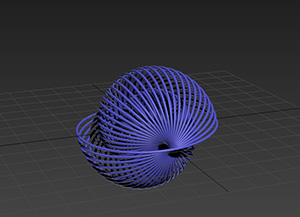
SuperHelix Presets - Ball of Wool GizmoSuperHelix Presets - Ball of Wool

Snail Shell
SuperHelix Presets - Snail Shell GizmoSuperHelix Presets - Snail Shell

Rope
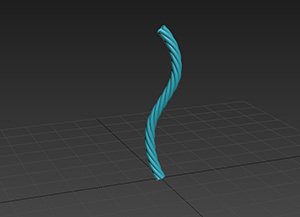
SuperHelix Presets - Rope GizmoSuperHelix Presets - Rope

Chinese Pagoda
SuperHelix Presets - Chinese Pagoda GizmoSuperHelix Presets - Chinese Pagoda

Fruit Basket
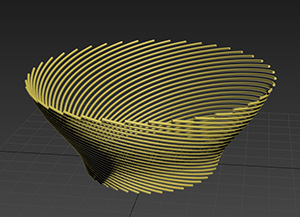
SuperHelix Presets - Fruit Basket GizmoSuperHelix Presets - Fruit Basket

Every preset was specially built to show the use of one or more parameters in conjunction with a particular gizmo structure.
For example, the presets Ball of Wool and Snail Shell make use of the Absolute Rotation parameter to achieve a kind of spherical volume.
Rope and Fruit Basket show the use of the Clone circularly tool to generate many helical splines around the path of the gizmo.
Chinese Pagoda shows how a low resolution value can be useful to give a geometrical look to the helix.

Take in consideration that the presets are just a set of predefined parameters and modified gizmos, but any gizmo shape and parameter settings can be achieved by starting from the default Basic Spring preset.

Here’s a Quick Start Tutorial to start playing with Presets and the Gizmo

Share