3 High-Quality 3ds Max Tools to Enhance Your Material Workflow

Tired of tweaking hundreds of materials by hand in 3ds Max?

Material-related tasks can become surprisingly repetitive and time-consuming when you’re working on large scenes. Adjusting the look of multiple materials, matching vegetation to a particular mood, or getting wood grain properly aligned across a large number of boards are some examples.

These three professional 3ds Max tools from One Click Tools save you from dealing with endless nodes in the 3ds Max Material Editor or tedious work in the Unwrap UVW Editor: Remate, Foliage Tint Master, and WoodFlow.

1. Remate — A Material Remote for 3ds Max

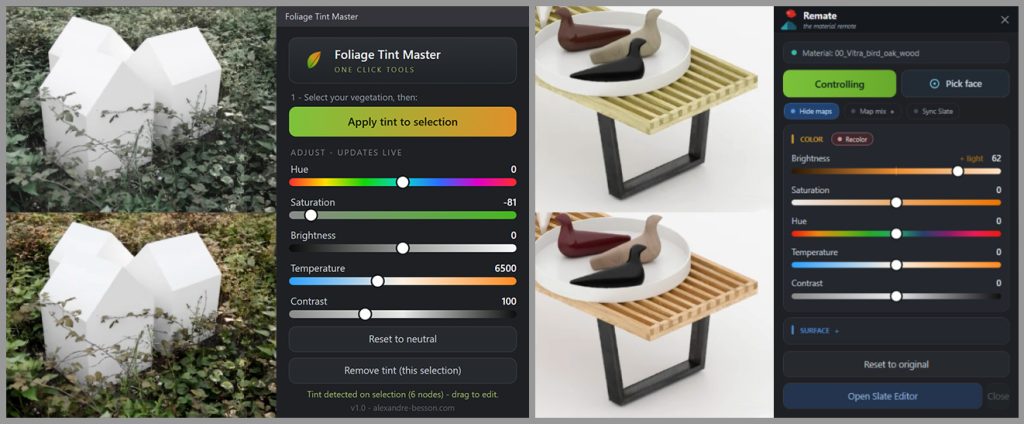
What if you could simply click a surface in the viewport and immediately start adjusting the material behind it?

That’s the idea behind Remate.

Instead of hunting through Multi/Sub materials or navigating complex node trees, you can click a face in the viewport and Remate identifies the corresponding material and brings its controls into a dedicated panel.

From there, you can adjust parameters such as brightness, saturation, hue, temperature, contrast, glossiness/roughness, bump and displacement, while working with Corona or V-Ray interactive rendering.

One particularly interesting feature is its relative per-material workflow. If you select multiple objects with different materials, Remate can preserve their individual variations instead of flattening everything to a single value.

And if you don’t like the result, the original material can be restored with a pixel-exact reset.

This tool is ideal for ArchViz and other 3ds Max workflows where materials need to be adjusted repeatedly during look development or client revisions.

Compatibe with 3ds Max 2021 or higher. Corona 9+ / V-Ray 6+

Learn more about Remate

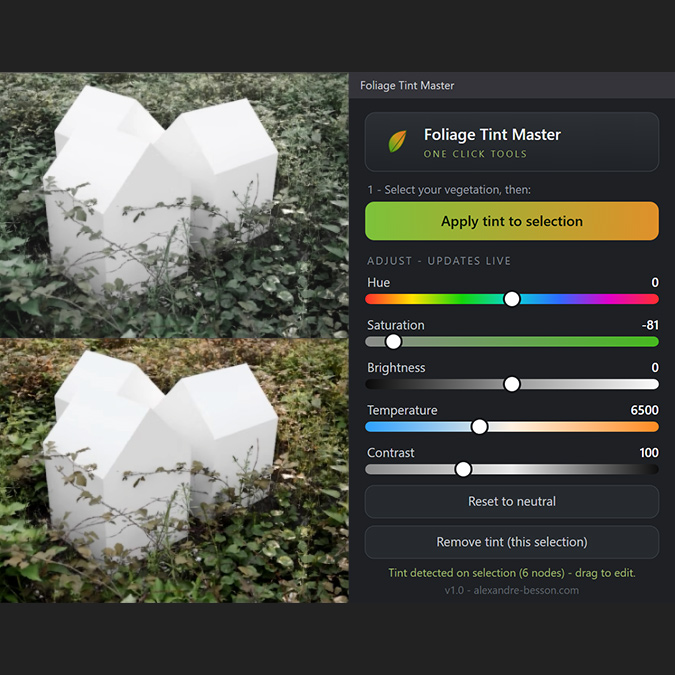
2. Foliage Tint Master — Fast Vegetation Grading

Your vegetation is too green, too saturated, or simply doesn’t match the mood of the scene?

This is a very common ArchViz problem — especially when working with vegetation libraries created for different scenes or lighting conditions.

Foliage Tint Master takes a very straightforward approach: select your vegetation, apply the tint, and adjust it using a set of dedicated controls.

You can work with Hue, Saturation, Brightness, Exposure, Temperature and Contrast, with the changes visible live under Corona or V-Ray interactive rendering.

The tool also supports per-channel tinting for albedo and translucency, as well as variation between instances and leaves, which can be useful when a vegetation scatter looks too uniform.

The workflow is non-destructive: the original textures aren’t modified, and the tint can be removed when needed.

This tool is ideal for ArchViz artists who regularly work with large vegetation setups and need to quickly adapt foliage to different scenes, seasons or lighting conditions.

Compatibe with 3ds Max 2024 or higher. Corona or V-Ray

Learn more about Foliage Tint Master

3. WoodFlow — Instant Wood Grain Mapping

Wood grain is easy to get wrong when every board needs a different orientation.

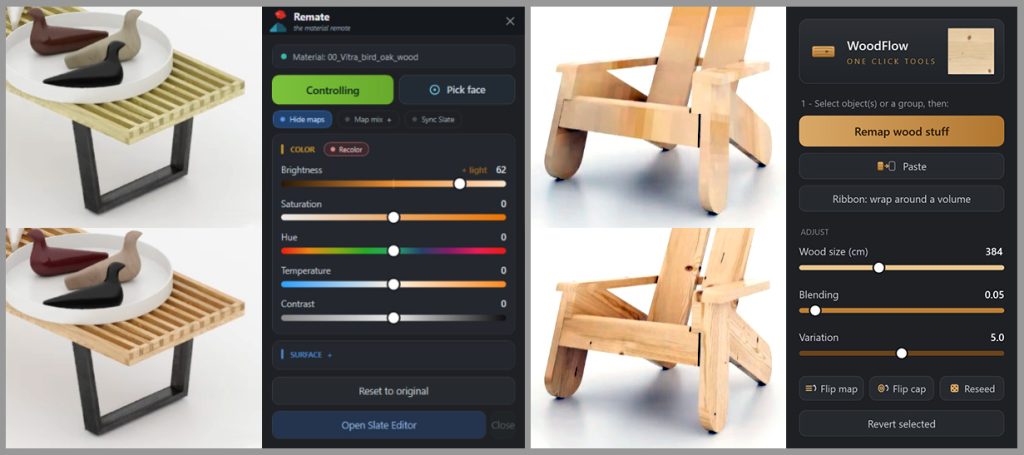
Instead of manually unwrapping individual boards and then correcting the orientation of the texture, WoodFlow analyzes the geometry and automatically aligns the wood grain along each board, plank or slat.

The same approach can be used from a single board to larger architectural elements such as wood-clad facades.

It’s one of those tools where the benefit is immediately apparent when you see it in action: less UV setup, less repetitive correction, and a more consistent result.

Idel for Architectural visualization and other 3ds Max projects involving a significant amount of wood geometry.

Compatibe with 3ds Max 2025 or higher

Learn more about WoodFlow


Affiliate Disclosure
This page may contain affiliate links. If you decide to purchase through them, we may earn a commission at no extra cost to you. These commissions help support the creation of free tutorials, articles, and tools on Spline Dynamics. We only recommend products that we believe provide real value to the CG and ArchViz community.

New Video: When the Real World Becomes a Digital Asset

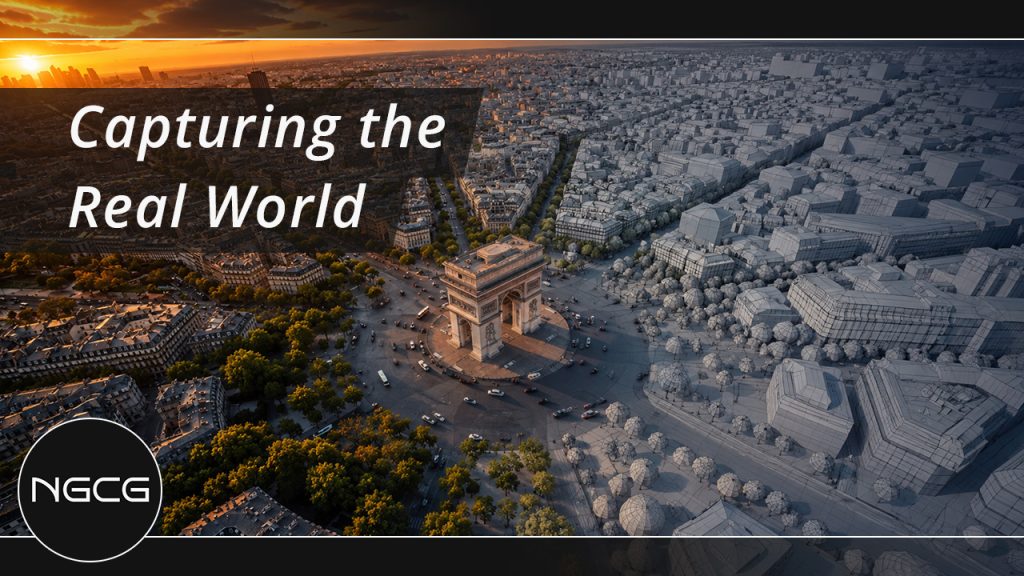
A new Next-Gen CG video explores how reality capture, AI generation and emerging 3D technologies are changing the raw material of digital production.

For most of CG history, building a digital world meant creating it — modeling objects, environments, cities and context by hand. Today, physical reality can increasingly be captured, reconstructed, streamed or generated at almost any scale.

But what happens when the world itself becomes available as raw material?

In this new video, we look at photogrammetry, LiDAR, AI-generated 3D, Gaussian splatting, geospatial data and emerging world models — and at the quieter shift taking place underneath all of them.

The interesting question may no longer be how we build every asset, but how we select, integrate, edit and direct the assets that are becoming available to us.

Watch the new Next-Gen CG video: When the Real World Becomes a Digital Asset

Read the full article

Share

Introducing NextGen CG: A New Video Series on the Future of Computer Graphics

Today we are excited to launch NextGen CG, a new YouTube series dedicated to exploring the technologies, workflows, and ideas shaping the future of Computer Graphics.

Rather than chasing product announcements or AI hype, the goal is to take a step back and examine what these technologies actually mean for artists, studios, and production pipelines.

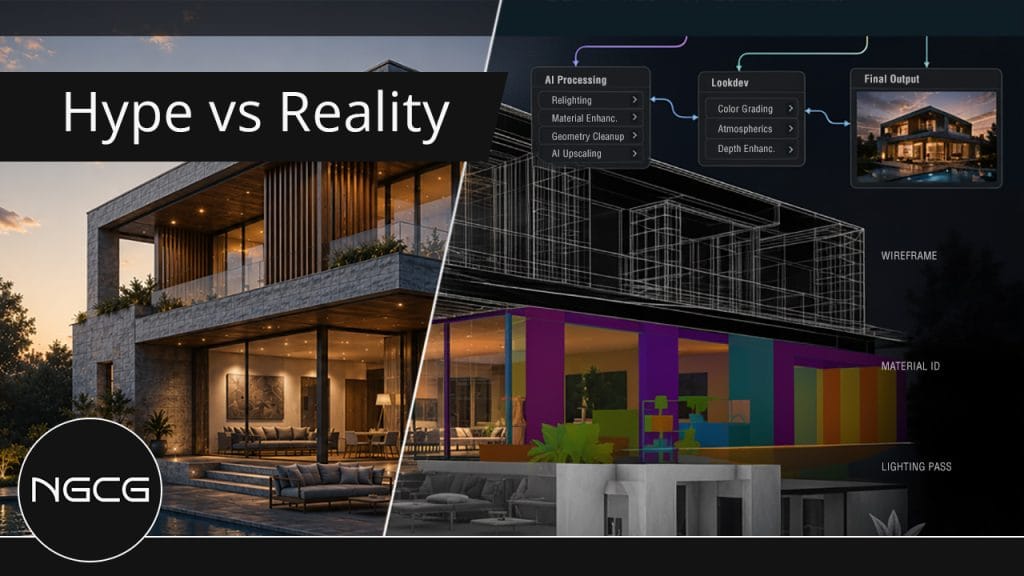
The first episode is based on the article AI-Assisted ArchViz: Beyond the Hype, published on SplineDynamics. It looks beyond impressive demos to explore how AI is really being used in professional Architectural Visualization, where it adds value today, where it still falls short, and how production workflows are evolving.

Future episodes will cover a much broader range of topics, including AI, real-time rendering, procedural workflows, simulation, VFX, animation, game development, XR, reality capture, digital twins, emerging standards, and other technologies transforming the CG industry.

Watch the first episode:
https://www.youtube.com/watch?v=Bh-2b4IO9Lg

Read the original article:
https://www.splinedynamics.com/blog/nextgen-cg/ai-assisted-archviz-beyond-the-hype/

Launching a new channel from scratch is never easy, so if you enjoy this kind of technical content, I’d really appreciate your support.

Please consider subscribing to NextGen CG, giving the video a like, and sharing it with anyone interested in the future of Computer Graphics.

Thank you for being part of the SplineDynamics community. I hope this becomes a valuable resource for artists, developers, and studios over the coming years.

Share

When the Real World Becomes a Digital Asset

A new article has just been published on the Spline Dynamics blog exploring one of the most important transformations currently taking place in computer graphics and digital content creation.

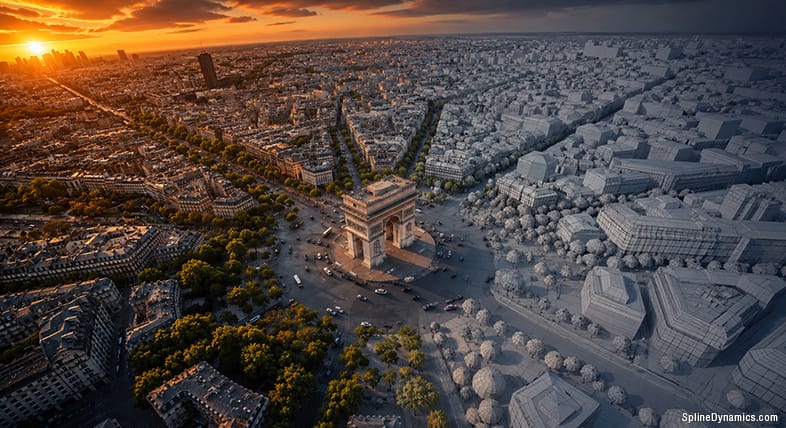
Over the last two decades, creating 3D assets has largely been a manual process. Today, advances in reality capture, AI-assisted reconstruction, photogrammetry, LiDAR, Gaussian Splatting and geospatial technologies are changing that paradigm. Increasingly, entire objects, buildings and even cities can be captured directly from the physical world and transformed into digital assets.

The article examines how these technologies are converging, the emergence of digital twins, the growing relationship between reconstruction and generation, and how the role of CG artists is evolving from manual asset creation toward curation, editing and pipeline integration.

Read the full article:
https://www.splinedynamics.com/blog/when-the-real-world-becomes-a-digital-asset/

Share

CameraMatch AutoSetup Adds Google Photorealistic 3D Tiles Integration

Jamie Cardoso has released a major update to his CameraMatch AutoSetup toolset for 3ds Max, Blender and SketchUp, with the headline feature being deep integration with Google Photorealistic 3D Tiles — the same photogrammetric mesh used by Google Earth, now importable directly into your 3D scene.

What’s New

  • Google Photorealistic 3D Tiles: Fetch real, accurate textured 3D models of any location straight into your scene (requires a free Google Cloud API key). New fine-tuning controls — Max Screen Space Error and Max Tile Depth — let you balance model detail against compute time.
  • GeoBuild + OpenStreetMap: Import OSM data to retrieve building outlines, heights and names in seconds for fast massing (note: roughly 5–10m offset, so Google Tiles win on precision).
  • Cropped Photo Tool: Got a pre-cropped image with distortion? Pick a horizon, extend the frame, and recover an accurate camera match.
  • Scene Scale Calculator: Read a real building’s height, apply it to the VP box, and your scene units update automatically to match the real world.

All of this builds on the core engine that already handles automatic vanishing-point detection, camera alignment, and the VP Verified Box for sanity-checking against real structures in your reference photo.

Compatible with: 3ds Max 2020+, Blender, SketchUp (GeoBuild and DroneSiteBuilder not yet available for SketchUp) — V-Ray, Corona, Arnold, Scanline, ART. Cinema 4D version in development.

The Three Licence Tiers — What’s Included

This is one integrated toolset sold across three licence levels. Here’s exactly what each one gives you:

Individual Freelancer/Hobbyist — $75

Includes CameraMatch AutoSetup + GeoBuild.

  • Single workstation, personal use
  • Full VP detection, horizon line, Cropped Photo Tool, Background Mode, FBX export, Scene Scale Calculator, renderer-aware camera creation, Camera Transplant, and more
  • GeoBuild: build a geo-referenced scene (terrain, satellite drape, OSM buildings/roads, land features) from an address or bounding box
  • Lifetime access to v6 updates

👉 Get the Individual Freelancer Licence

Small Studio (up to 5 users) — $99

Includes CameraMatch AutoSetup + GeoBuild + DroneSiteBuilder Enterprise.

  • Up to 5 named workstations, priority email support
  • Everything in the Freelancer tier, plus DroneSiteBuilder Enterprise: drop a folder of drone photos in, and get a complete 3D site (cameras + terrain + OSM context + optional Google 3D Tiles) in about 90 seconds
  • All platforms: 3ds Max, Blender, SketchUp editions

👉 Get the Small Studio Licence

Enterprise/Corporate (Tier 1 Firms) — $850

Includes CameraMatch AutoSetup + GeoBuild + DroneSiteBuilder Enterprise.

  • Unlimited seats, site-wide deployment
  • Priority support + Q&A access
  • One year of bespoke development of additional 3D tools/scripts tailored to your studio’s workflow
  • Full feature set + DroneSiteBuilder Enterprise, same as Small Studio, scaled for large firms

👉 Get the Enterprise Licence

Quick Reference

TierCameraMatch AutoSetupGeoBuildDroneSiteBuilder
Individual Freelancer
Small Studio
Enterprise

If you only need camera matching and basic geo-context building for solo work, the Individual Freelancer licence covers it. If you work with drone photography and want full automated site assembly, you’ll need the Small Studio licence or above.

Free manual available for download on Jamie Cardoso’s blog.


Spline Dynamics is an affiliate partner for these tools via Gumroad.

Share